Unlearning the World to Rediscover Yourself through Ancient Wisdoms and Cultures
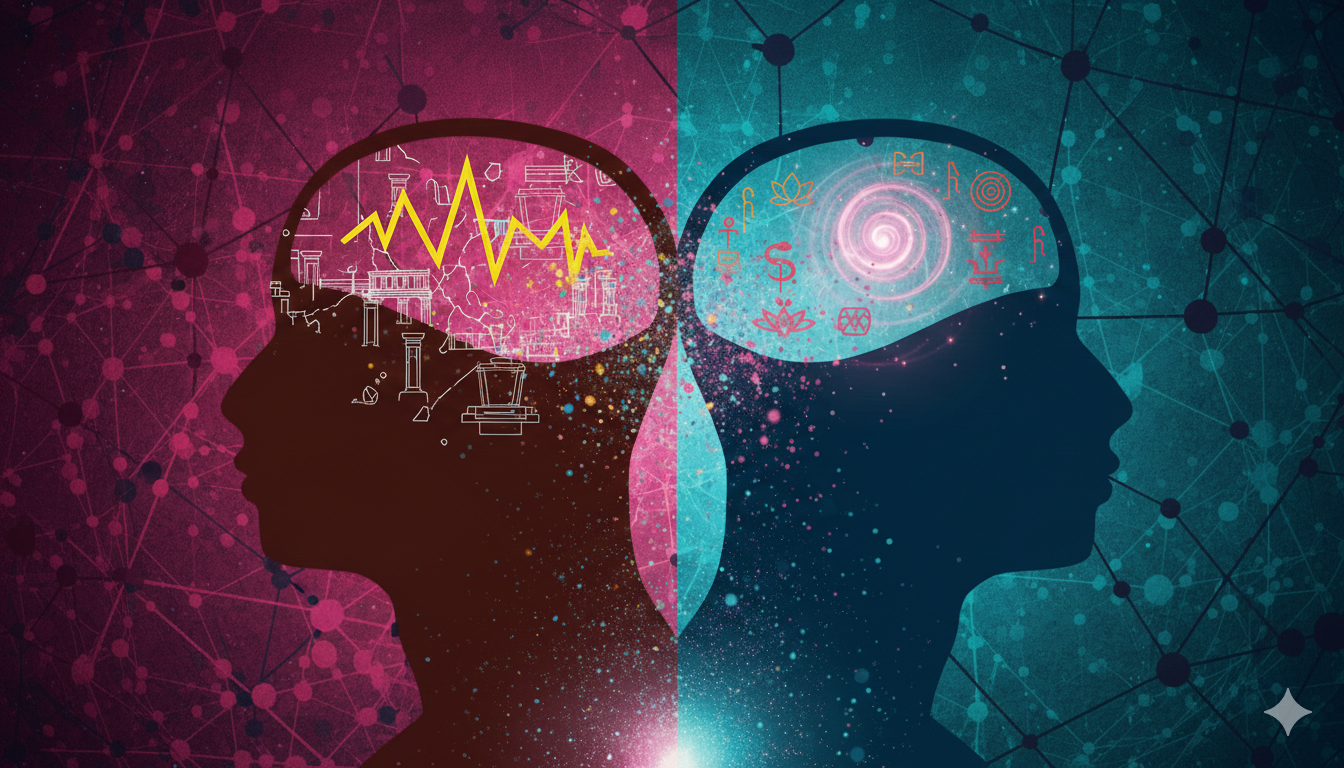
We all live inside a model — a map of reality built from beliefs, experiences, education, and cultural conditioning. It’s the invisible architecture shaping how we see the world, how we define success, how we interpret truth, and even how we perceive ourselves.
But here’s the paradox: your model is not the world. It’s just a model — a filtered projection of reality.
Modern society rewards conformity to collective models: economic systems, political ideologies, scientific paradigms, religious institutions. Each claims to offer the truth. Yet beneath the noise of competing truths lies a deeper question few dare to ask:
What if the very framework through which you interpret reality is flawed?
The Illusion of Knowing
From an early age, we are taught what to think, not how to see.
We inherit narratives about who we are, what matters, and how the world works.
But those narratives are products of time and place — they’re not absolute truths.
Ancient traditions understood this. The sages of India spoke of Maya — the great illusion that veils reality. In Taoism, the Tao that can be spoken is not the eternal Tao. In Indigenous wisdom, knowledge is experiential — a dialogue with nature, not a conquest over it.
To unlearn the world is not to reject knowledge but to transcend conditioning. It is to question the lens itself — to realize that perception is not passive but creative.
Rediscovering the Inner Map
When you peel away cultural programming, what remains is a kind of primordial awareness — unfiltered, expansive, deeply interconnected.
Ancient cultures viewed the self not as a separate entity but as part of a living cosmos. The Egyptian concept of Ma’at, the balance of order and harmony, reflected this interdependence. The Aboriginal Dreamtime describes a timeless reality where all beings are woven into one continuous story.
And then there is Ethiopia — a civilization that quietly carries one of the oldest living models of time and health on Earth. While most of the world follows a 12-month Gregorian calendar, Ethiopia lives by its 13-month solar calendar, a rhythm more closely attuned to celestial cycles. In this model, time flows differently — more harmoniously, less constrained by industrial constructs.
Fasting — The Ancient Model of Renewal
Ethiopia also preserves an ancient health model centered on fasting — a spiritual and physical discipline deeply woven into daily life.
For much of the year, Ethiopians practice periods of abstinence from meat and dairy, guided by the ancient Orthodox calendar. But fasting here is not merely dietary; it is a form of purification, balance, and realignment.
Modern science now confirms what ancient cultures already knew — that fasting regenerates cells, resets metabolism, and enhances mental clarity. Yet beyond biology lies something deeper: fasting reminds us that consumption does not define existence.
In stillness and emptiness, the body remembers its wisdom. The mind becomes clear. The spirit reconnects with the eternal.
This is the essence of ancient health models — not treatment after imbalance, but living in rhythm with nature, with seasons, with silence. Fasting, prayer, and reflection were once the technologies of inner alignment. They were how humanity maintained harmony with the cosmos.
The Path of Unlearning
Unlearning is not destruction; it’s liberation.
It means detaching from rigid belief systems, opening to paradox, and embracing mystery as a teacher.
To unlearn is to allow silence to speak louder than opinion.
It is to find truth not in ideology but in direct experience.
When we look at ancient practices like Ethiopian fasting or the 13-month calendar, we see not superstition but a science of harmony — a wisdom modernity has forgotten in its pursuit of convenience.
A New Model — or No Model at All
The ultimate realization is that no single model of the world can contain truth. Every map is partial. Every perspective is limited.
And yet — when you dissolve the boundaries between them, something extraordinary happens: you remember who you are beyond all models. You become the observer, the creator, and the mystery itself.
Final Reflection
Maybe the question isn’t “Is your model of the world correct?” but rather:
Are you willing to unlearn it — to see with new eyes, to rediscover yourself through the wisdom that time forgot?
Because in a world obsessed with knowing, rediscovery begins with unknowing.
 English
  Portuguese
  Spanish