What It Means for the Individual in the Next 5–10 Years
The empire was never just a kingdom — it was an idea.
An illusion of order built upon laws, currencies, and narratives of control.
But as with all empires before it, the foundations begin to tremble when belief fades.
We stand at the precipice of such a moment — a global unraveling.
The so-called “rules-based international order,” the system that shaped the modern world after World War II, is fracturing under the weight of its contradictions.
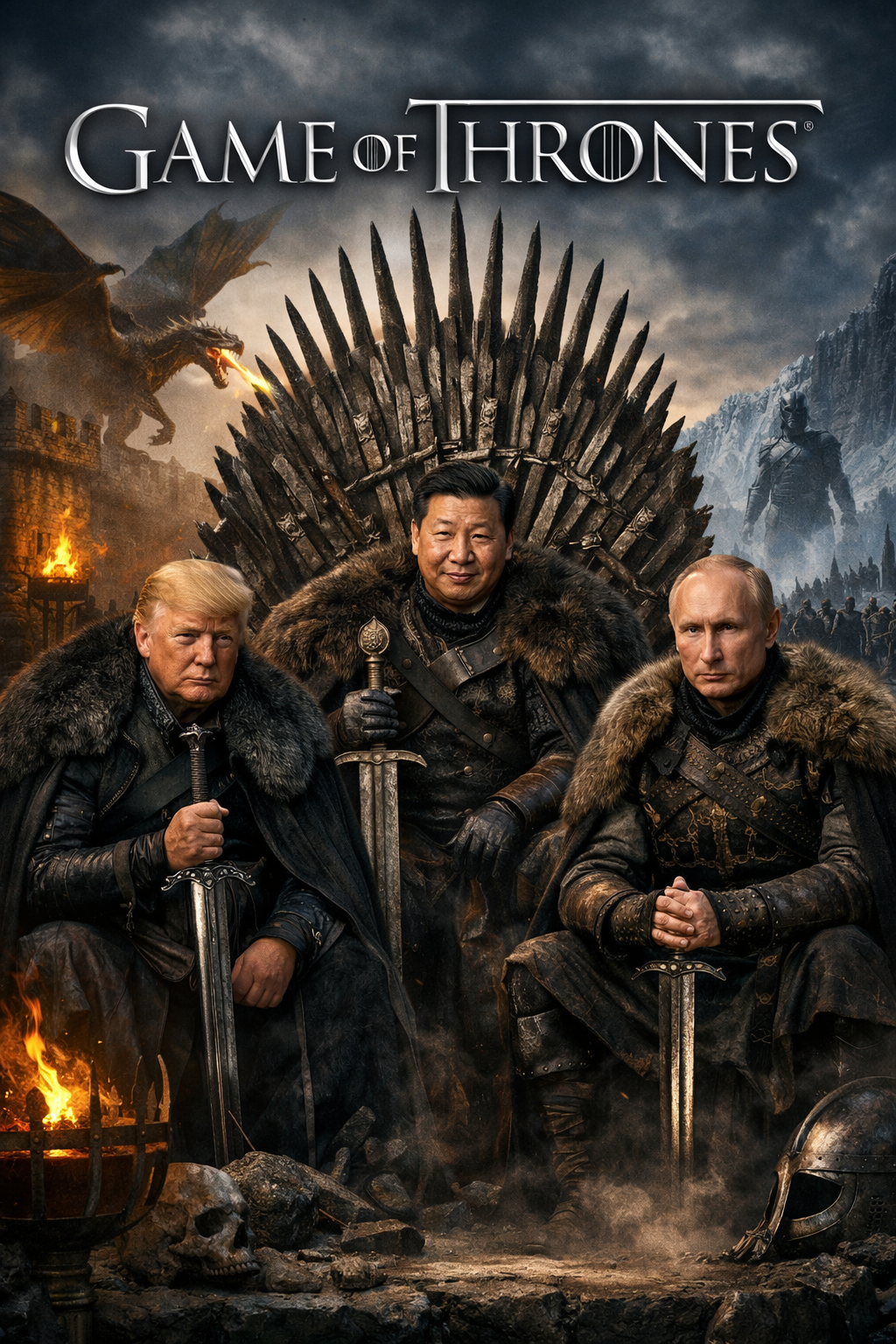
The Game of Thrones is no longer fiction — it’s the world stage.
And we are all pieces on the board.
The Empire Without a Center
For decades, a single narrative governed the world: democracy, free markets, globalization — the promise of endless growth.
It worked until it didn’t.
Now, the illusion of stability is shattering: alliances fracture, currencies wobble, and the myth of Western supremacy collides with the rise of new civilizational powers.
The empire no longer has a clear ruler — only factions fighting for dominion.
Nations speak of sovereignty, yet their economies are bound by invisible chains of debt and data.
Technology, once the tool of liberation, has become the new empire — algorithmic, borderless, and unaccountable.
This is the new terrain of power: not land, but narrative.
Not armies, but information.
And the individual — once a citizen — is now both commodity and combatant.
The Great Fragmentation
We are entering a multipolar world — not just politically, but psychologically.
Every culture, every ideology, every digital tribe is building its own reality tunnel.
Globalization promised unity, but the human mind can only process so much contradiction.
Now the collective consciousness splinters — into nationalism, digital escapism, spiritual revivalism, and techno-utopian dreams.
The collapse of a rules-based order is not just the fall of systems — it’s the fracturing of meaning itself.
Like ancient Rome before its decline, or the Ottoman Empire before its disintegration, the signs are clear: inflation of currency, corruption of language, disillusionment of youth, and the rise of spectacle over substance.
What It Means for the Individual
The next 5–10 years will test the very definition of freedom, work, and identity.
Institutions you once trusted — governments, banks, universities, even media — are entering crisis.
But collapse does not always mean catastrophe.
It can also mean transformation — the composting of an old world so a new one can emerge.
In the age of empire collapse, survival will not come from allegiance to systems — but from sovereignty of mind.
From developing resilience, adaptability, and inner clarity amid chaos.
Those who thrive will be the ones who understand that empires rise and fall, but consciousness endures.
The true frontier is no longer geographic or political — it is psychological and spiritual.
To navigate the next decade, the individual must evolve from passive subject to conscious participant — reclaiming authorship of reality itself.
The New Order: Decentralization of Power
As centralized empires falter, a new model begins to take shape — decentralized, networked, and peer-to-peer.
The blockchain revolution, digital communities, and decentralized governance systems (DAOs) are not just technological trends; they are early blueprints for post-imperial civilization.
The empire was vertical.
The new world is horizontal.
This shift mirrors something deeper — a collective yearning to return power to the individual, to the community, to the local and the human.
But this transition will not be seamless. It will be turbulent, contested, and often chaotic.
The Choice Before Us
The collapse of empire confronts each of us with a choice:
Will we cling to the decaying order, or participate in the birth of a new paradigm?
In Game of Thrones, power was defined by the ability to command others.
In the world emerging before us, power will be defined by the ability to command oneself.
Empires crumble. Economies shift. But awareness — the inner kingdom — remains.
And it is from that inner sovereignty that the next civilization will be built.
Final Reflection
History reminds us that when empires fall, myths are rewritten and new realities take root.
The next 5–10 years will be remembered as the turning point — the end of one world, and the uncertain birth of another.
The question is no longer who rules the empire,
but rather: Who will rule within?